
Online Exam Security with Real-Time Tracking (RTT)
Online Exam Security with Real-Time Tracking (RTT)As education and exam processes continue to digiti...
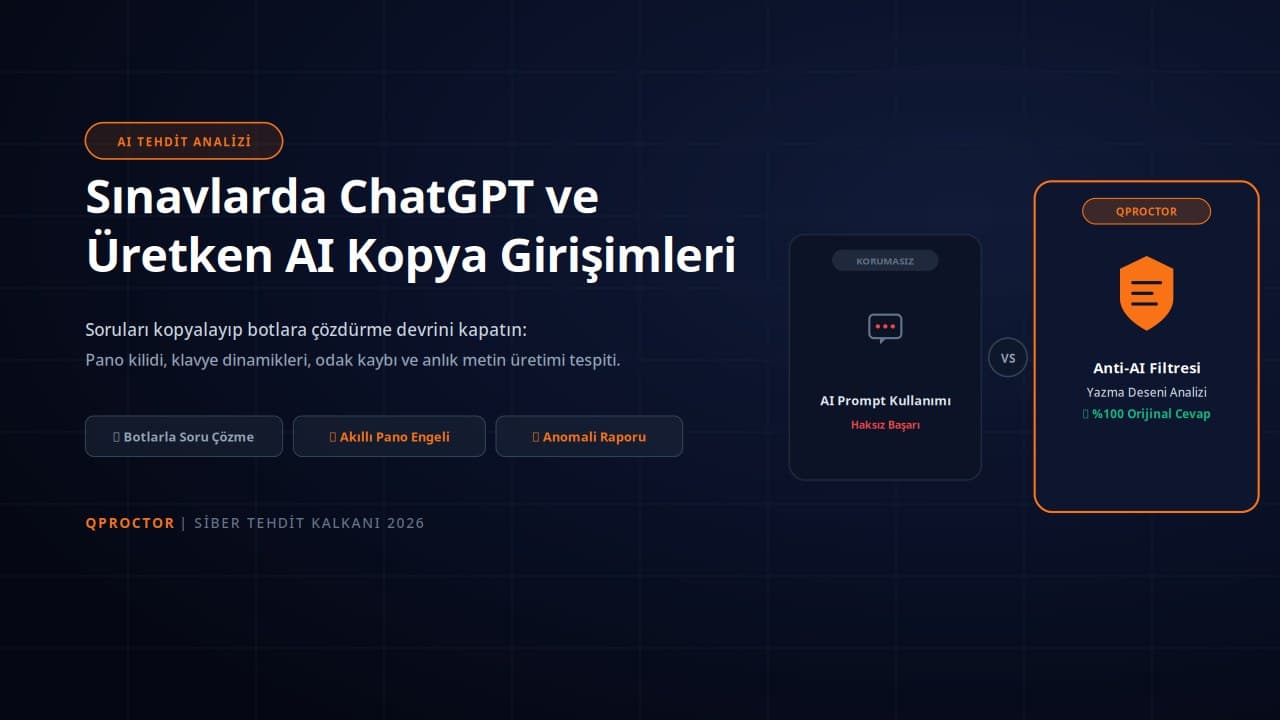
Ensuring the security of online assessments has taken on an unprecedented dimension for educational institutions, universities, and corporate academies with the development of generative AI (ChatGPT, Gemini, Claude, etc.). Beyond traditional methods such as candidates copying questions, casting their screen to another display, or searching in other tabs, having ChatGPT solve exam questions within seconds simply by taking a photo or reading them aloud has now become a widespread form of cheating.
Passive tools that only lock the computer screen are completely inadequate against these clever cheating scenarios. Protecting integrity and fairness in the digital world is possible only with QProctor AI-Powered Exam Security smart proctoring solutions that analyze not only the screen but also the physical and audio environment at the same time.
Generative AI-based cheating is a new form of misconduct in which candidates get AI assistance from external sources by using physical blind spots or smart assistants, without directly copying and pasting.
Although standard screen-locking software freezes tabs, it is completely powerless against the following modern cheating methods:
Taking a picture of a question with a phone positioned just behind the keyboard or below the screen, where the computer camera cannot see it, and sending it to AI.
Whispering the question through tiny, invisible earpieces and receiving a spoken answer from an AI assistant.
Getting help from other people or AI through a second screen placed right next to or behind the computer.
AI's ability to read images as well as text (using optical character recognition, or OCR) allows candidates to cheat using secondary devices even when they say, “I never left the screen.” QProctor's mobile second-camera support fully closes this loophole by bringing the candidate's hands, desk, and surrounding area under monitoring as well.
Establishing a physical and autonomous protective shield that goes beyond the digital realm is the most critical step in merit-focused assessment:
Monitors only the computer camera and screen. It cannot detect smart devices, headphones, or conversations around the candidate, whether on or beside the desk. It is completely defenseless against AI-assisted cheating.
In addition to the computer camera, it positions a smartphone as a second camera. AI-powered gaze tracking identifies where the candidate is focused, audio analysis detects whispers, and autonomous scanning immediately detects nearby objects.
Select the security measures used in your exam to estimate the likelihood of students cheating with AI (ChatGPT, etc.).
Your current methods cannot prevent a candidate from using an AI assistant on a second device.
Modern education and assessment centers must invest not only in restrictions but also in smart detection systems to protect exam security:
Assess whether your exam infrastructure is prepared for AI threats:
Secure exams not with yesterday's technology, but with today's AI. Protect merit against AI-assisted cheating with near-high accuracy using QProctor's autonomous gaze, object, and audio detection technologies and locked browser (QBrowser).
Continuous synchronization of computer and mobile cameras makes it physically impossible to cheat using secondary devices.
An acoustic spectrum analyzer scans the faintest whispers and audio frequencies to prevent cheating with smart assistants.
By tracking the candidate's eye and head movements, it logs within seconds when they focus on blind spots other than the screen (such as notes or a phone).
It does not automatically disqualify the student from the exam; it reports moments identified as risky to the instructor for review, with video timestamps.
Test the latest dual-camera and AI-powered security solutions for your university or education center.
Request a Free Demo and InformationWork with the QProctor team to assess a proctoring, identity verification, environment analysis, and reporting workflow suited to your institution.