
Online Exam Security with Real-Time Tracking (RTT)
Online Exam Security with Real-Time Tracking (RTT)As education and exam processes continue to digiti...
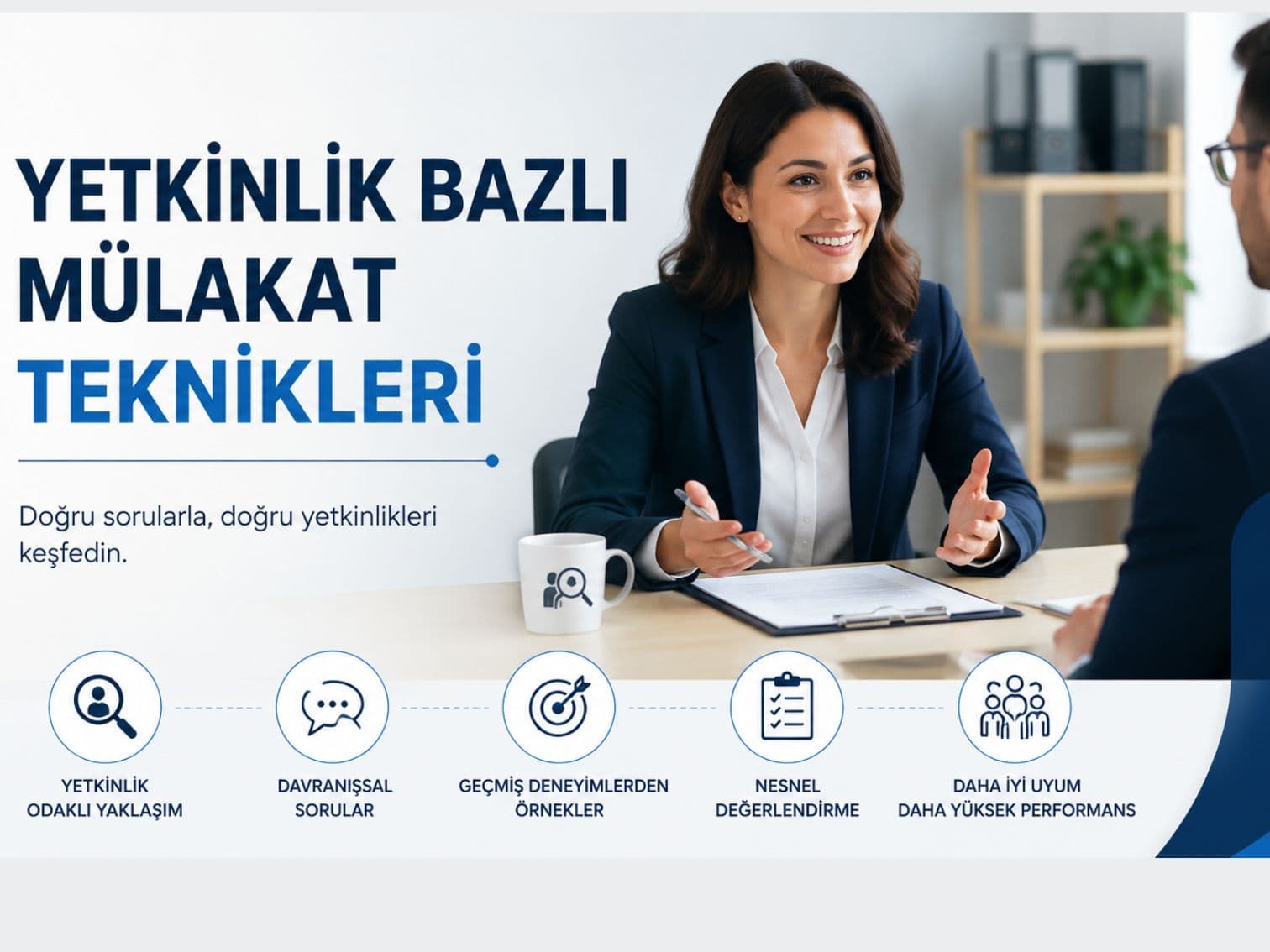
Traditional hiring methods typically focus on how candidates present themselves, the appeal of technical phrases in their résumés, and the interviewer’s immediate personal affinity. However, modern human resources management and industrial psychology research has proven that unstructured, intuitive interviews of this kind are extremely poor at predicting job performance. Behavioral or competency-based interviews, by contrast, are based on the principle that a candidate’s concrete past performance and behavior are the strongest and most reliable predictors of future job success.
Large-scale meta-analysis studies conducted by Schmidt and Hunter, covering more than 86,000 hiring records, clearly reveal the gulf between the validity coefficients of different types of interviews in predicting job success. Unstructured interviews offer predictive validity close to the level of random selection, at 0.20, while competency-based structured interviews more than double this rate, bringing it to 0.51. When the process is supported by Behaviorally Anchored Rating Scales (BARS), the validity coefficient reaches the highest scientific level, at 0.57.
A competency-based interview is a scientific assessment methodology that measures a candidate’s core behavioral, cognitive, and interpersonal competencies for a role through their past experience, using standardized questions for every candidate.
| Interview Methodology | Predictive Validity (R) | Cognitive Process and Decision-Making Mechanism | Organizational Risks and Errors |
|---|---|---|---|
| Traditional / Unstructured | 0,20 | Assessment based entirely on intuition, immediate affinity, and “gut feeling.” | Halo/reverse halo effect, confirmation bias, and unfair candidate comparisons. |
| Semi-Structured | 0,35 | Candidate stories are freely explored within a flexible conversational flow. | Subjectivity risks persist, and consistency is lost when different questions are asked of each candidate. |
| Structured / Competency-Based | 0,51 | The same competency questions are asked of all candidates, who are assessed against standardized criteria. | Potential development areas of candidates without direct experience may be overlooked. |
| BARS-Supported Structured | 0,57 | Candidate responses are matched with concrete, observable behavioral scale anchors. | The development process is time-consuming and requires continuous updates to keep pace with rapid changes in job roles. |
Korn Ferry and SHRM competency modeling is a corporate design process that standardizes human resources planning by dividing the critical work behaviors expected of roles in modern organizations into rational, measurable categories.
In U.S.-based human resources standards, strategic competency design is based on two main schools of thought: the Korn Ferry Leadership Architect (KFLA) and the Society for Human Resource Management (SHRM) Competency Model. The SHRM approach emphasizes that human resources professionals should be business partners who shape organizational strategy, not merely administer processes. In this model, competencies are grouped into three core clusters—Leadership, Interpersonal, and Business—and aligned directly with organizational goals.
The Korn Ferry Leadership Architect (KFLA), in turn, classifies 38 behavioral competencies with proven validity worldwide under four factors: Thought, Results, People, and Self. One of the most critical and distinctive features of this model is the “Developmental Difficulty Rating” parameter for each competency at different organizational levels. These ratings, which range from 1 (easiest) to 5 (most difficult), indicate how much time, effort, and developmental flexibility a candidate will need to acquire and demonstrate the relevant competency on the job.
| KFLA Factor | Core Competency | Definition and Behavioral Scope | Difficulty Rating | Impact on Work Outcomes and Success |
|---|---|---|---|---|
| Thought | Strategic Mindset | Accurately anticipating future possibilities and turning them into competitive, groundbreaking strategies. | 5 (Most Difficult) | Enables the creation of sustainable growth strategies by anticipating future market trends. |
| Thought | Decision Quality | Making sound, timely, and rational decisions that enable progress. | 2 (Easy) | Directly improves overall organizational performance by increasing operational efficiency. |
| Results | Ensures Accountability | Ensuring that one’s own and others’ commitments are met and taking responsibility. | 2 (Easy) | Fosters a culture of learning from mistakes and builds a sense of ownership within teams. |
| Results | Optimizes Work Processes | Designing the most effective and efficient processes with a focus on continuous improvement. | 3 (Moderate) | Improves workflow by eliminating unnecessary costs and operational inefficiencies. |
| People | Collaborates | Building strong partnerships across the organization to achieve shared goals. | 2 (Easy) | Breaks down silos between departments and creates inclusive environments with high engagement. |
| People | Builds Effective Teams | Building highly synergistic teams by combining diverse talents and perspectives. | 5 (Most Difficult) | Reduces employees’ intention to leave and maximizes team engagement. |
| Self | Manages Ambiguity | Working effectively when matters are unclear and the way forward is uncertain. | 5 (Most Difficult) | Supports the organization in moving forward without losing direction during fast-changing crises. |
Korn Ferry research shows that competencies explain more performance variation than a candidate’s past experience, personal motivation, or educational background. This reinforces the strategic importance of measuring behavioral dimensions alongside technical skills in hiring decisions. In global leadership models, leaders’ ability to foster high engagement within their teams, reduce turnover, and create a sustainable performance climate depends directly on accurately assessing specific people-focused competencies such as “Builds Effective Teams,” “Instills Trust,” and “Develops Talent” during interviews.
Behaviorally Anchored Rating Scales (BARS) are a systematic assessment method that scores a candidate’s interview responses by matching them with concrete, observable behavioral anchors established in advance through job analysis, rather than relying on subjective judgments.
One of the most common errors assessors make in recruitment and selection—the leniency bias—and subjective assessment criteria can be minimized through the use of Behaviorally Anchored Rating Scales (BARS). Establishing a BARS framework involves a five-stage methodological process led by the human resources department and requiring the active participation of business units:
This dimension assesses how the candidate builds partnerships across the organization to achieve shared goals and fosters a culture of working together.
| Scale Value | Performance Level | Behavioral Anchors (Candidate Indicators) |
|---|---|---|
| 1 | Below Standard | Resists teamwork; belittles or sabotages the views of other departments; prioritizes individual goals by avoiding information sharing. |
| 2 | Developing | Participates in collaboration reluctantly and only when required; tends to dominate communication and disregard others’ contributions and ideas. |
| 3 | Meets Standards | Communicates respectfully within the team; takes part in shared projects and tasks with a sense of responsibility; aligns with constructive joint decisions during conflict. |
| 4 | Exceeds Standards | Actively encourages the involvement of different perspectives and departments; guides peers by sharing experience and improves shared processes. |
| 5 | Outstanding / Role Model | Builds cross-functional collaboration and a culture of working together across the organization to break down silos; mediates high-tension interdepartmental conflicts and develops solutions. |
This dimension analyzes how the candidate takes action to address disruptions in work processes and create value without receiving formal instructions.
| Scale Value | Performance Level | Behavioral Anchors (Candidate Indicators) |
|---|---|---|
| 1 | Below Standard | Avoids taking responsibility; even when faced with a clear operational problem, waits for direct instructions or guidance before intervening. |
| 2 | Developing | Performs routine tasks but cannot take initiative when faced with non-routine obstacles, hesitating and delegating the solution to a manager or others. |
| 3 | Meets Standards | Acts proactively to resolve problems within their knowledge and authority; tries rational, logical alternatives to overcome obstacles that have not become chronic. |
| 4 | Exceeds Standards | Analyzes potential risks in advance and takes preventive action before a crisis develops; goes beyond the job description to initiate process improvement projects. |
| 5 | Outstanding / Role Model | Takes responsibility during strategic crises involving high uncertainty and risk; delivers lasting, scalable solutions that make a tangible financial/operational contribution to the organization. |
STAR and EAR interview question design is a structured question-design model that examines a candidate’s past situation (Situation), the task they took on (Task), the actions they performed (Action), and the results they achieved (Result) using chronological, measurable data.
The assessment process should be treated not as a “highlight reel” of the candidate’s career, but like an analysis of the raw game footage; what matters here is the chronological consistency of decisions, not flashy statements.
| STAR Component | Weak Candidate Response | Strong Candidate Response | Interviewer Probing Questions |
|---|---|---|---|
| Situation | “At my previous company, the launch date for a very important project was approaching, but we had fallen significantly behind schedule because work had piled up within the team and technical issues had arisen.” | “Four weeks before migrating to a new e-commerce infrastructure that would affect 15% of our annual revenue target at my previous company, we were two weeks behind schedule because of a data integration error.” | “What was the daily financial cost of this delay to the company, and how did stakeholders initially respond?” |
| Task | “My manager knew how urgent the situation was, so they asked me to solve the problem and make sure the project was completed as soon as possible.” | “I took responsibility for resolving the integration crisis, ensuring the launch happened on the planned date with zero errors, and managing stakeholder communication.” | “When you took over the process, what concrete metrics did you use to define success, and what was the biggest constraint you faced?” |
| Action | “I immediately organized emergency meetings. I told my teammates to work faster, updated task assignments, and made sure everyone worked overtime.” | “I conducted a criticality analysis and postponed three non-essential features until after the launch. I set up daily 15-minute sync meetings to remove blockers and allocated additional resources to the testing team.” | “What criteria did you use to select the features to postpone? What data did you present to get the additional resource budget approved?” |
| Result | “In the end, thanks to the team’s hard work, we managed to complete the project on time, and management was very pleased with our performance.” | “We completed the launch two weeks ahead of the revised schedule. We kept the go-live error rate at 2% and achieved the target revenue. I learned the importance of flexibility during a crisis.” | “What mistakes did you make during this process? If you faced the same crisis today, which part of the process would you manage differently?” |
Assessor Note: Select a BARS score (1–5) for each competency based on the candidate’s interview performance. The weighted total score and hiring recommendation will update dynamically.
The candidate’s core competencies are at a balanced level.
A candidate scorecard is an HR process document that standardizes a candidate’s performance in weighted, role-specific competency areas using a concrete BARS scale after the interview and ensures consistency in decisions among interviewers.
To maximize hiring accuracy, six golden rules must be followed meticulously when using a scorecard:
Reduce external assistance, cheating attempts, and AI misuse during competency-based assessments and foreign-language interviews to zero with QProctor’s enterprise-grade protection infrastructure.
Our merit-based recruitment and selection systems improve interview quality (QoH) while minimizing the cost of mis-hires (Cost of Mis-Hire) by 90%.
Prevents candidates from opening new browser tabs, copying and pasting, and using external applications during interviews or written exams.
Scans the direction of candidates’ pupils and their head movements in real time, detecting attempts to cheat by looking away from the screen within milliseconds.
Filters out background whispers, another person’s speech, and earbud-based cheating in foreign-language or technical interviews.
Performs depth analysis to verify that the candidate is physically present in real time; blocks photo, video, or deepfake impersonation.
Work with the QProctor team to assess the proctoring, identity verification, environment analysis, and reporting workflow that suits your organization.