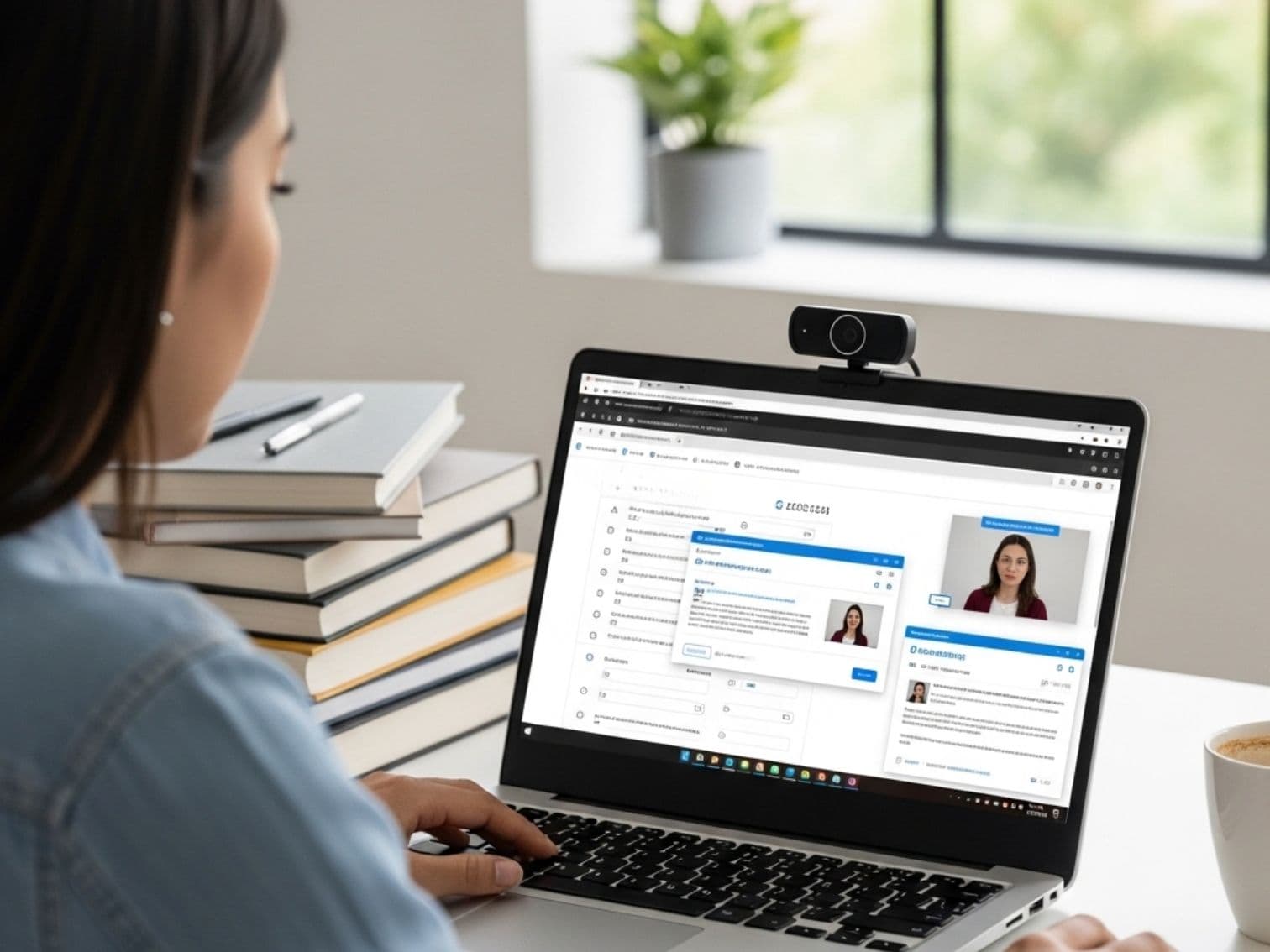

Online Exam Security with Real-Time Tracking (RTT)
Online Exam Security with Real-Time Tracking (RTT)As education and exam processes continue to digiti...
In this QProctor guide, for a wide range of decision-makers—from human resources professionals to university administrators, school principals to public officials—we will cover online exam and interview software integration; online interview systems, online proctoring (proctoring) system architectures.
An online exam system is a digital assessment platform that runs on cloud infrastructure, includes AI-powered proctoring, biometric identity verification, LTI integration, and automated scoring components, and enables candidates, regardless of their geographical location, to securely take an exam through digital measurement and assessment.
Online exam systems are configured to meet different operational needs in higher education, K-12 education, public-sector examinations, and corporate recruitment processes.
Different organizational segments view the online assessment ecosystem from entirely different perspectives.
Expanding the candidate pool by eliminating geographical constraints, time-to-hire reduction and increased assessment objectivity are key priorities. Structured online interview and psychometric test integration directly improves hiring quality.
Their priorities include protecting academic integrity and preventing cheating on midterm and final exams.
Gamified exam systems suitable for primary and high school age groups are a priority.
When hundreds of thousands of candidates access the system simultaneously the risk of system crashes, biometric verification against deepfake and morphing attacks, national security standards, and cloud scalability are among their priorities.
In modern talent acquisition processes, online tools have expanded the candidate pool globally while significantly shortening time-to-hire the time required. However, this speed can pose certain challenges to maintaining objectivity in the candidate assessment process.
Research in industrial-organizational psychology has demonstrated that unstructured interviews are the method most susceptible to assessors' unconscious biases and the weakest at predicting job performance. Due to the nature of the online format, job-irrelevant variables such as a candidate's room background, internet quality, or camera angle can distort perceptions.
The biggest conceptual pitfall for HR professionals is treating "reliability" (reliability) and "validity" (validity) as equivalent concepts.
The capacity to produce similar results when repeated with the same candidate. Even a flawed test can be reliable by consistently producing the same incorrect result.
How accurately the test measures the construct it claims to measure and how successfully it predicts the candidate's future job performance predictive accuracy. According to APA standards, this is the decisive criterion.
| HR Performance Metric | Definition | Target Value | Optimization Strategy |
|---|---|---|---|
| Inter-Rater Reliability | Consistency of scores across different interviewers (Cohen's Kappa) | > 0.70 | Regular calibration sessions, concrete behavioral scenarios |
| Quality of Hire | Correlation between the performance score for the first 6 months and the interview score | > 4.0/5.0 | Periodic alignment of interview questions with position dynamics |
| Offer Acceptance Rate | Percentage of candidates who accept offers | > %90 | Smooth interview experience, EVP transparency |
| D&I Alignment Rate | Proportional equivalence between the applicant pool and those hired | Equivalent to the pool | Resume anonymization, creation of diverse panels |
Approximately 63% of higher education institutions have integrated online exam proctoring systems at the institutional level. However, this widespread adoption has created academic integrity and student privacy a difficult ethical dilemma between them.
Online proctoring systems use a combination of AI-powered behavioral algorithms, lockdown browsers, and remotely connected human proctors. The candidate's webcam, microphone, on-screen activity, and gaze focus are analyzed throughout the exam.
| Proctoring Model | Mechanism | Contextual Judgment | Scalability | Ethical Risk |
|---|---|---|---|---|
| Human-Centered | Trained proctors monitor via webcam | Very High | Low | Privacy concerns (human monitoring) |
| Fully Automated (AI) | Artificial intelligence detects anomalies based on rule sets | Very Limited | Very High | Algorithmic bias, high false positive rate |
The question we should really be asking is, "How can we design assessments of such high quality that there is no need to monitor students?" Authentic assessments require students to apply their abstract knowledge to real-world scenarios, and their answers cannot be found through search engines.
When civil service, professional qualification, and language certification examinations move online; deepfake technologies, injection attacks, and face morphing techniques are among the threats that may be encountered.
In a morphing attack; algorithms blend the actual candidate's photograph with the facial features of an impersonator to create a hybrid photograph. When this fake image is incorporated into an identity document, standard facial recognition systems mistakenly approve the impostor. In injection attacks , synthetic video is streamed directly into the examination platform through virtual camera drivers.
It confirms a "live human" by reading micro-expression changes, reflections of screen light on the skin, blinking frequencies, and color changes in blood vessels within milliseconds.
The candidate's identity is continuously verified throughout the exam through facial biometrics, keystroke dynamics (keystroke analytics), and movement analysis.
For hundreds of thousands of concurrent users CDN, load balancer and auto-scaling infrastructure. LTI 1.3 Advantage seamless integration with enterprise systems through the standard.
| Security Framework | Scope and Focus | Audit Format | Geographic Impact |
|---|---|---|---|
| ISO 27001:2022 | Information Security Management System (ISMS), 114 control points | Independent certification valid for 3 years | Global — a prerequisite for public tenders |
| SOC 2 (Type 2) | AICPA Trust Services Criteria: Security, Availability, Privacy | Independent auditor's attestation report | US-focused, a global standard in the SaaS industry |
| GDPR | Data minimization, consent, portability, the right to be forgotten | A fine of up to 4% of turnover in the event of a violation | All platforms processing EU citizens' data |
A candidate having a visual impairment, hearing loss, a motor skills impairment, or a cognitive difference related to neurodiversity (dyslexia, ADHD, autism spectrum) does not mean that their intellectual capacity is diminished. If the platform is built with poor universal design, the candidate because they cannot overcome digital barriers is doomed to fail.
All online exam platforms W3C Web Content Accessibility Guidelines (WCAG) 2.1 Double-A (Level AA) must fully comply with the standard. The ADA (US), Section 508, and the European Accessibility Act (EAA) carry legal sanctions.
that your organization is considering the online exam platform check whether it meets the following criteria:
Select the criteria and see the result:
Review the proctoring, identity verification, environment analysis, and reporting workflow suited to your institution with the QProctor team.